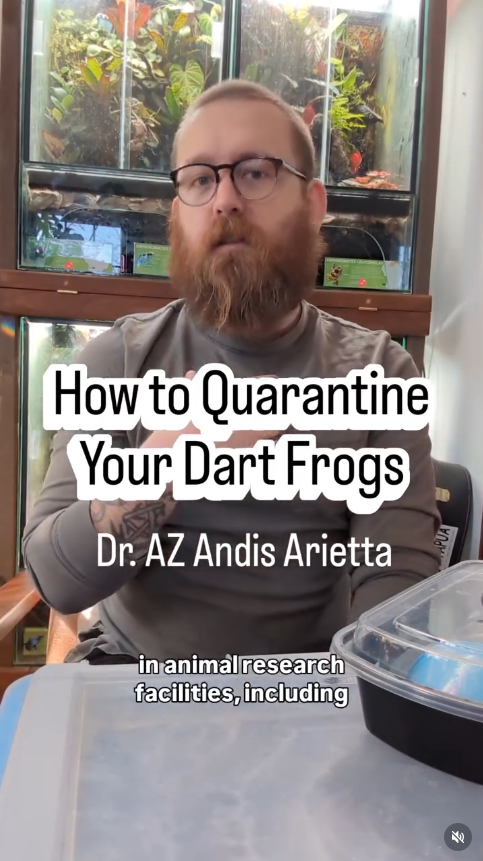
Amphibian diseases are a major concern, both at the scale of global population conservation and for hobbyists protecting their pets and collections at home. Unfortunately, the nature of the vivariums makes the dart frog hobby especially susceptible to rapid spread of many pathogens that thrive in moist conditions. Fungal diseases like Bd can easily persist in bioactive setups and be easily transferred on animals, plants, soil, or even droplets of water.
However, strict quarantine and observation protocol can essentially eliminate the threat of disease in home collections. Below, I will detail the standard operating procedures I use here at Holotypica. Most of these are practices I developed while working with laboratory populations of frogs under strict biosafety control standard and IACUC review.
Quarantine Standard Operating Procedures
I define three levels of quarantine of increasing severity. All quarantine happens outside of my main animal room(s) and I have a dedicated set of tools (mister, tongs, feeding cups) for the quarantine animals. The order of operations to go from ‘clean-to-dirty’ or ‘cleared-to-quarantine,’ meaning that I do all care of the main collection first, and then move on to the quarantine enclosures. I take care of quarantine enclosure from Level 1 to 3 in order. You must always wash hands or change gloves between cleared and quarantined enclosures. You should change gloves between every quarantine enclosure.
Timeline
Any animal coming into my collections from a trusted source undergoes 90-120 days of Level 1: Long-term quarantine in a naturalistic tote, set up similarly to a standard vivarium. If there are no concerns, I clear the animals for introduction to the collection. Animals from any questionable source (e.g. rehoming from another keeper, buying from a new breeder, etc.) go into Level 2: Short-term quarantine in a sterile hospital enclosure for 10-20 days. If there are no concerns, then then go into the 90-120 day Level 1 quarantine. In addition, any animal with symptoms of disease goes into the Level 2 quarantine for observation and testing.
If symptoms worsen or tests come back positive for pathogens, I elevate the animal to Level 3: Medical quarantine. Level 3 quarantine is identical to Level 2 in care, but I keep them entirely separate, with another set of dedicated tools for Level 3.

Quarantine Timeline
Organisms from trusted sources go directly to Level 1 while those of possible concern begin at Level 2. Those suspected of or positively tested for a disease move from Level 2 to Level 3.
Set-ups
Level 1 involves long-term isolation and observation of ostensibly healthy animals prior to introduction to a collection. The set-up for Level 1 quarantine is basically a disposable vivarium. I use a 40 quart gasket tub with ventilation holes covered by 40-mesh screen. The substrate is aquarium filter foam topped with leaf-litter. I add plants and coconut or cork hides. I will cohabitate animals from the same cohort (usually from the same purchase group or import group, by species). The purpose of Level 1 quarantine is to make long-term quarantine easy for me and low-stress for the animals. In the best case scenario, the animals will stay in Level 1 quarantine for 90 to 120 days and then be cleared to go into their permanent enclosure. If the animals are cleared, then the quarantine tub can be reused, as is, for the next set of animals.

Level 1 Quarantine Set
I set up Level 1 – Long-term quarantine in a 32 quart gasketed tote with aquarium foam bottom covered in leaf litter. I add plants and clean-up crew as I would in a typical vivarium. I use 40-mesh screen on the vents.
Level 2 quarantine is intended for short-term observation of potentially sick animals. The set-up for Level 2 is a ‘hospital tub’. Animals are kept individually in a sterile condition. For most species, I use 32 ounce take-out containers with a plastic hide and damp paper towel as substrate. For larger species, I use either a 64 ounce food storage container. I modify the lids with a vent hole covered with gauze and a hole to administer water or flies. The purpose of Level 2 quarantine is to closely observe animals with suspected disease. By changing the paper towel daily, it is easy to monitor and collect feces for testing. By using tightly sealed food containers and gauze, it is also easy to monitor how many flies are consumed. The disadvantage of Level 2 quarantine set-ups is that they are a lot of work and a lot of stress on the frogs. In the lab, I replace the entire set-up daily and wash the materials in the dishwasher. You could also do this at home (depending on the acquiescence of your housemates) or dispose of the setup. In the best case scenario, an animal in Level 2 quarantine can be tested and cleared in 1-2 weeks and go back into Level 1 quarantine. If the animal tests positive or symptoms do not improve, the animal advances to Level 3 quarantine.

Level 2-3 Quarantine Set-up
I set up Levels 2 & 3 as sterile, hospital enclosures. Damp paper towel as substrate and a plastic hide are the only contents. The enclosure is changed daily. I use gauze over a vent hole and a hole for administering flies and water covered with tape. It is important to ensure that the contain is completely fly-proof in order to monitor food consumption.
(The bottom image shows how these set-ups can also be used for metamorphing frogs.)
Level 3 quarantine is practically the same set-up as Level 2. However, Level 3 animals are known positive for a contagious pathogen, so extra care and sterile technique need to be followed. Ideally, Level 3 set-ups would be housed entirely off-site from a primary collection. If a Level 3 animal can be treated and tested clear of the pathogen, then can be elevated to Level 2 and then Level 1.
Resources
Poole VA, Grow S (eds.). Amphibian Husbandry Resource Guide, Edition 2.0. Association of Zoos and Aquariums (AZA) Amphibian Taxon Advisory Group, 2012.
Pessier AP, Mendelson JR III (eds.). A Manual for Control of Infectious Diseases in Amphibian Survival Assurance Colonies and Reintroduction Programs (Version 2.0). IUCN/SSC Conservation Breeding Specialist Group in collaboration with Amphibian Ark, San Diego Zoo, Zoo Atlanta, 2017.
Reiss AE, Woods RW (eds.). National Zoo Biosecurity Manual (First Edition). Zoo and Aquarium Association (Australasia) and partners, 2011.