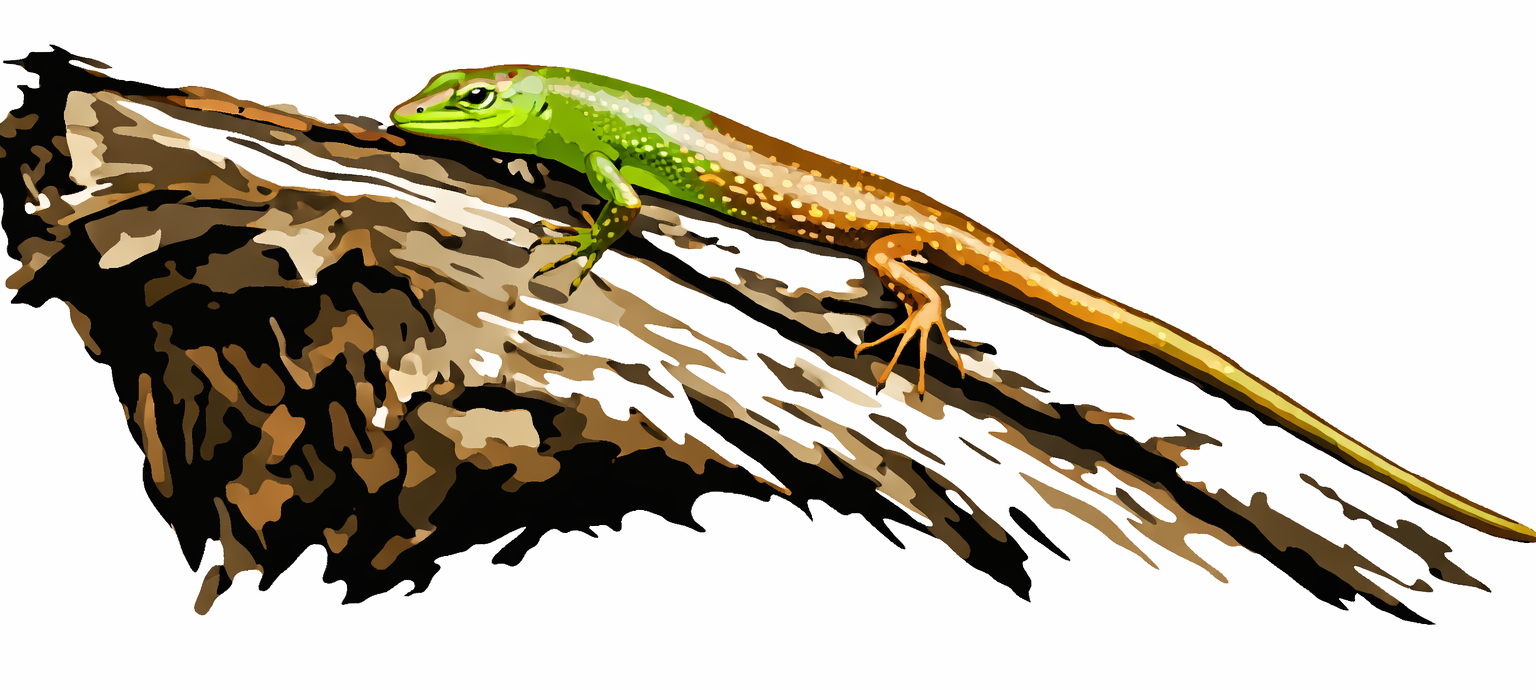
Abstract (TL:DR)
Emerald tree skinks (Lamprolepis smaragdina) have become increasingly common in captivity, where two phenotypes are especially familiar: an all-green morph and a black-spotted morph. Hobbyists often treat these as simple variants of the same species, but it remains unclear whether they instead represent distinct regional lineages that should be maintained separately in captivity. To investigate this question, I compared phenotypic patterns, geography, published phylogeographies, historical taxonomy, and wildlife trade records. I phenotyped 720 research-grade iNaturalist observations and grouped them into six recurring morphs based primarily on dorsal pattern and hindlimb coloration. When mapped geographically, these morphs were strongly structured rather than randomly distributed. Brown-hindlimb morphs dominate the Philippines and Solomon-linked populations, while green-hindlimb morphs are concentrated in Sulawesi and west Pacific island populations. This phenotypic structure broadly aligns with published phylogenetic analyses and with historical subspecies concepts. U.S. import data further suggest that the two captive morphs likely derive from different export countries, with the all-green morph associated primarily with the Solomon Islands and the black-spotted morph associated with Indonesia. Taken together, these lines of evidence support the view that the common captive morphs are not trivial color variants but representatives of divergent lineages within the L. smaragdina complex. For that reason, they should be treated conservatively in the hobby and maintained as separate lines whenever possible.

Biogeographic history
Emerald Tree Skinks, as a species, Lamprolepis smaragdina, is a highly diverse population that is prevalent across the Southeast Asia, Oceania, and western Pacific archipelagos. The species is present in high density, in some cases representing the largest proportion of vertebrate biomass on some islands.
The biogeographic history of the species is complex. Historically, populations were split through tectonic and volcanic geology as the island archipelagos formed, a process of vicariant divergence. In addition, populations moved among islands through “waif dispersal” (a.k.a. sheer luck) when storms and currents rafted individuals across ocean barriers. Populations have also been transported by humans. For instance, populations were introduced to the Mariana Islands (and probably Guam) during military operations (Hileman et al. 2020).
The taxonomy of emerald tree skinks has always been difficult to pin down. The species was first described by René Primevère Lesson in 1826 during a round-the-world exploratory expedition (Fig. 2) (Lesson 1826). The species was later shuffled through the genera Scincus, Lygosoma, and Dasia, before Greer ultimately settled on the current placement as Lamprolepis smaragdina in 1970 (see exhaustive synonymy).

Throughout time, as many as eight subspecies have been described (acutirostre, elberti, moluccarum, perviridis, philippinica, pisangense, smaragdina, and viridipuncta), as explorers and researchers sought to put a naming structure to the diverse phenotypes and scattered populations across disparate islands.
Nowadays, only the subspecies philippinica is used out of convenience, but most researchers recognize that L. smaragdina is a much more complex melange of distinct populations and phenotypes than the old subspecies names can capture.
Phenotyping
First, I wanted to see how unique the phenotypes that we see in the hobby are among the wild population. For instance, it could be the case that the species has a lot of polymorphic variation and we simply ended up with a couple of morphs by luck in the hobby that persisted due to founder effects. Or, there could be distinct clades across the range and the hobby phenotypes could be representative of those existing populations.
To get a sense of the phenotypes in the wild, I downloaded all 1060 existing research grade observations of the species from iNaturalist (see data availability in references). I then randomized the images and systematically phenotyped all of the images that showed enough of the animal with good enough clarity (n = 720). After grouping and regrouping the images, I settled on six distinct phenotypes that I could reliably classify (50-50, saddleback, all-green, brown, black-spot, and hypermelanistic).

The ‘50-50’ morph is characterized by a green anterior and bronze/brown posterior. Salt and pepper spotting is usually present on the posterior dorsal coincident with the brown coloration, but can extend anteriorly over the green portion of the dorsum (Fig. 3). The forelimbs can be brown (usually with white or salt-and-pepper mottling) or green. The hindlimbs are always brown (usually with white or salt-and-pepper mottling). This morph is consistent with the philippinica subspecies.

I noticed that a portion of the images I had originally grouped with the ‘50-50’ phenotype exhibited green tails and sometimes a reduction in the total proportion of brown relative to green on the dorsum. I called this the ‘saddleback’ morph because the brown wraps around the posterior of the body where the hindlimbs join, but the green base-color is present both anteriorly and posteriorly (Fig. 4).

The ‘all-green’ phenotype corresponds to the standard green morph present in the hobby. The body and tail are entirely green, while the hindlimbs are always brown (usually with white or salt-and-pepper mottling) (Fig. 5). The forelimbs can be brown (usually with white or salt-and-pepper mottling) or green. The salt-and-pepper patterning present on the dorsal of the ‘50-50’ and ‘saddleback’ morphs is sometimes present in a reduced form in this phenotype, but is usually absent.

The ‘brown’ phenotype exhibits the brown pattern of the ‘50-50’ and ‘saddleback’ morphs over the entire extent of the body, with more or less pronounced salt-and-pepper spotting (Fig. 6).

The ‘black-spotted’ phenotype exhibits the green base color similar to the ‘all-green’ morph, however, the hindlimbs of this morph are green rather than brown (Fig. 7). Black spotting can be present on both the dorsum and limbs, but is sometimes reduced to almost complete absence.

The ‘hypermelanistic’ morph is a mostly uniform dark yellow-brown across the body (Fig. 8). Unlike the ‘brown’ morph, the salt-and-pepper spotting is absent and the base-color is darker with more of a yellow-green tone rather than the light brown base-color of the ‘brown’ morph.

It is important to note that the hindlimbs are diagnostic in differentiating the ‘black-spotted’ morph from the ‘all-green’ morph. The hindlimbs of the ‘all-green’, ‘saddleback’, ‘50-50’, and ‘brown’ morphs are brown with white spots. In fact, I think of these four morphs as almost a continuum of the brown pattern originating from the hindlimbs and spreading over the remainder of the body (Fig. 9). In contrast, the ‘black-spotted’ morph always has hindlimbs with a green base that may or may not present with black spotting or mottling. The ‘hypermelanistic’ morph is basically a darker version of the ‘black-spotted’ morph and has similar but darker hindlimbs.
Pheno-geography
Remember, all of the phenotyping was done agnostic to geography. If the population simply had high levels of polymorphism, we would not expect to see patterns by geography. However, after mapping the phenotypes to their geolocations, I found that there are some very clear patterns (Fig. 10).


The most stark patterns can be seen in the Philippines, Solomon Islands, and Sulawesi. Only brown hindlimb morphs (‘brown’, ‘saddleback’, ‘50-50’ and ‘all-green’) are found in the Philippines. And only the green hindlimb morphs (‘black-spotted’ and ‘hypermelanistic’) are found on the west Pacific islands (Fig. 11.).
Only the ‘all-green’ morph is found on the Solomon Islands (with the odd exception of record 224099710). The only brown limb morph consistently present on Sulawesi is the ‘brown’ morph, but is limited to the northern half. The south half of the island is limited to the ‘black-spotted’ morph (Fig. 11).
The ‘saddleback’ morph is almost entirely constrained to the Philippines. The more typical philippinica type, the ‘50-50’ morph, is prevalent on the Philippines, Lesser Sunda Islands and occasional records on western New Guinea and the Bismarck Archipelago. Neither is present on Sulawesi or the Solomon Islands (Fig. 11).
The ‘all-green’ morph from the hobby is present in the Philippines, across New Guinea, the Bismarck Archipelago, Lesser Sunda Islands, and heavily distributed in the Solomon Islands, but not Sulawesi (Fig. 11).
The ‘brown’ morph is constrained to the western part of the species range in the Philippines, eastern Sunda Arc, and northern Sulawesi (Fig. 11).
The ‘black-spotted’ morph is found heavily on both southern peninsulas of Sulawesi and the Lesser Sunda Islands. Notably, this morph is most associated with the small, distributed islands of Micronesia in the western Pacific, from Palau north to Guam and the Mariana Islands and east to the Marshall Islands (Fig. 11).
The ‘hypermelanistic’ morph coincides almost entirely with the ‘black-spotted’ morph in the southern Micronesian islands (Fig. 11).
A note on subspecies
When Lesson originally described the species, he detailed two species: smaragdina and viridipunctus. The illustrations predate the written description of the species and are therefore the holotypes for the (sub)species. Lesson’s smaragdina (Latin for ‘emerald’) resembles the ‘black-spotted’ morph in appearance, for example uniform green with green hindlimbs and possible black mottling around the nares and eyes, rather than the ‘all-green’ morph, given the absence of brown patterning on the hindlimbs. The viridipunctus holotype image resembles the ‘hypermelanistic’ morph. The name viridipunctus means ‘green spotting’ which also fits the ‘hypermelanistic’ phenotype which looks uniformly brown with green speckling on the lateral surfaces, a pattern which is also represented in Lesson’s holotypic images.

The location of Lesson’s travels aboard the La Coquille also points to alignment with the ‘black-spotted’ and ‘hypermelanistic’ morphs. The La Coquille is only documented to have made port on the Island of Kosrae in the Caroline Islands Archipelago in the west Pacific where only the ‘black-spotted’ and ‘hypermelanistic’ morphs are found (Fig. 10).
Phylo-geography
The phenotypic patterning alone indicates that the morphological differences represent stable and relatively distinct populations. But there is further evidence in genetic structure among the populations as well.

Linkem et al. (2012) conducted a phylogenetic study of 204 specimens across most of the species range (although the Solomon Island, Lesser Sunda Arc, Java, and western New Guinea populations were absent). They found six clades when looking at mitochondrial markers (Fig. 13). These clades largely recapitulate the boundaries between phenotypes.
For instance, the marked difference in phenotypes split across the northern and southern halves of Sulawesi corresponds to clearly genetically distinct populations (Fig. 13). Also, multiple, distinct populations are apparent in the Philippines, and these are sister clades to the south (Fig. 13).
Linkem’s Clade 6, which closely resembles the distribution of the ‘all-green’ morph on New Guinea, falls out as sister to the Philippine clades (Fig. 13). This taxonomy supports my observation of the morphs with brown hindlimbs (‘all-green’, ‘50-50’, ‘saddleback’) as a continuum of phenotypes. However, the ‘brown’ morph, which corresponds to Linkem’s Clade 2 is shown as sister to the ‘black-spotted’ population on Sulawesi (Linkem’s Clade 1) rather than the other brown hindlimb morphs (Fig. 13).
Another discrepancy between phenotypic and genotypic patterns occurs in Clade 6. In Linkem’s phylogeny, this clade includes populations from Peleng Island off of Sulawesi, eastern New Guinea, the Bismarck Archipelago, and north to Palau and the Mariana Island populations. The spread of occurrences makes this grouping unlikely. Also, the phylogenetic relationships are geographically implausible. The largest branch, which excludes the monophyletic Peleng samples, is paraphyletic with all other samples (including a monophyletic Solomon Island group) nested within two groups of Palauan samples. Overall, my read is that Clade 6 is more of an artifact of undersampling western New Guinea, the larger Solomon Islands, and Caroline Island populations.
While Linkem et al. did not sample the Lesser Sunda populations, Reiley et al. (2025) focussed entirely on these populations. The Lesser Sunda Islands are an interesting subset of the species range because they are the only area where both the brown hindlimb and green hindlimb phenotypes substantially overlap. This may be unsurprising, given that dominant currents in the region act as a funnel from the rest of the species range toward the sieve that is the Lesser Sunda Archipelago (see Reily et al. 2025 Fig. 1). In addition, the direction of human commerce makes recent introductions from across the range likely as well.

Reiley et al. found widespread and distinct genetic structure across the populations they sampled. There is strong divergence between insular island populations (e.g. Atauro, Wetar, Flores, Lombok) as well as divergence within island populations (e.g. Timor). This pattern reinforces Linkem’s findings on Sulawesi which indicate that distinctions between populations are maintained via reproductive isolation.
This last point is key. In other words, even if/when there is dispersal between populations there are reproductive barriers–for instance, gametic isolation, mate preference, niche disparity, etc.–that prevent introgression.
Given the lack of hybridization in the wild, it makes sense to me that we should want to avoid forced hybridization in the hobby. Not to mention that these genetic analyses point toward a taxonomic revision of Lamprolepis smaragdina into multiple species in the future. Maintaining the fidelity of locale bloodlines, or at the very least phenotypes and import cohorts, seems prudent.
Imports
The final question is, “Which locales are currently present in the hobby?” To answer this question, I downloaded records for all wildlife imports and exports from US ports between 2014 and 2022 (LEMIS data from Marshall et al. 2025).

Just under 10,000 emerald tree skinks have passed through US ports between 2014 and 2022 (n = 9422). The vast majority (n = 9087) are animals that were imported into the US trade.
Records show that nearly all emerald tree skinks in the US come from just two countries: the Solomon Islands (98%) and Indonesia as a distant runner-up (2%).
As far as I have seen, only the ‘all-green’ and ‘black-spotted’ morphotypes are present in the U.S. and European captive populations. And the ‘all-green’ morph is the most prevalent, by far.
We will likely never know exactly where individual imports were collected in the wild due to the nature of wildlife trade. Animals are often collected from multiple locations by independent harvesters who transport animals back to an importer who transports them to a shipping hub. However, we can make strong assumptions from the distribution of morphs in relation to the country of origin of imports.
Given that the ‘black-spotted’ morph is not present in the Solomon Islands, it is clear that the provenance of this morph in the hobby must be Indonesia. It seems most likely that imports originated from the population on Sulawesi or adjacent islands. Some imports may have come from the Sunda Islands or Java; however, this seems unlikely given that the ‘50-50’ is far more common there, yet it has not been imported (as far as I know). Likewise, it seems much more likely that the provenance of the hobby’s all-green morph is the Solomon Islands, since that is the only morph present there.
Conclusion
Taken together, the phenotypic, geographic, phylogenetic, and trade evidence all point in the same direction. The two emerald tree skink morphs most familiar in the hobby, the all-green and the black-spotted, do not look like arbitrary variants drawn from a single polymorphic population. They look like representatives of distinct regional lineages with different biogeographic histories.
The all-green morph present in the hobby appears to align most strongly with Solomon Islands exports and with the broader brown-hindlimb lineage that includes the Philippine and New Guinean forms. The black-spotted morph in the hobby, by contrast, appears to align with Indonesian exports, most plausibly Sulawesi and nearby islands. The black-spotted morph conforms with the green-hindlimb west Pacific lineage that also includes the hypermelanistic form, which is likely the locale detailed in Lesson’s original holotype of the species. These are not minor cosmetic differences. The hindlimb pattern, dorsal patterning, geographic structure, and available genetic data all suggest deep divergence rather than casual variation.
That does not mean every individual in the hobby can be assigned to a precise island or locality. Wildlife trade is messy, and exporter labels are crude. But it does mean that hobbyists should be cautious about treating all emerald tree skinks as interchangeable. If these lineages are already evolutionarily distinct, and may eventually be taxonomically split, then mixing them in captivity would erase divergence that the wild populations have preserved over time.
For that reason, I think the most responsible approach is to maintain the all-green and black-spotted morphs as separate lines whenever possible, and to preserve any locality or import-cohort information that accompanies them. Even where exact provenance is unknown, keeping these phenotypes separate is a reasonable hedge against collapsing distinct lineages into a single captive muddle. In a species complex as geographically fragmented and taxonomically unsettled as Lamprolepis smaragdina, preserving distinction is better than recreating ambiguity.
References and Data Availability
Data Resources
GitHub repository with code for figures and analyses.
iNaturalist records with phenotypic codes available as a csv on GitHub or this Sheets link. When viewing in sheets, the images will render in the browser.
LEMIS data from Marshall et al. (2025) filtered for Lamprolepis smaragdina that was used in this analysis is available on GitHub.
References
Greer, AE. 1970. The Relationships of the Skinks Referred to the Genus Dasia. Breviora (348): 1-30.
The Reptile Database: Lamprolepis smaragdina species account.
Citation
If you use or refer to this article or the associated GitHub repository, please cite as:
Arietta, AZA. (2026). More Than Morphs: Geography, Lineages, and Trade in Emerald Tree Skinks (Lamprolepis smaragdina). holotypica.com/more-than-morphs-emerald-tree-skinks/.